The Draft Truth Series
Hi again! This post is a preview of our upcoming, analytics-focused series called Draft Truth. We haven't dove deep into pre-draft rookie rankings, so we figured it would be worth zooming out a bit and looking at how recent rookies fared and if there are any trends we can extract to inform our drafting.
Every draft cycle follows a familiar pattern. Players rise and fall based on combine results, highlight clips, and shifting narratives (Josh Allen's 14 year old tweets!) Production is cited, debated, sometimes dismissed. The NFL Combine matters, except when it doesn't. Landing spots are debated before they even exist. By the time the draft arrives, there is no shortage of opinions. What’s often missing is a clear answer to a simpler question:
What actually predicts fantasy success?
This series takes a step back from player-by-player analysis and focuses on that question directly. Instead of scouting individual prospects, it looks at broader patterns: what tends to matter historically, and what does not.
The goal is not to eliminate uncertainty. It is to use data to make it more manageable. This is also the kind of question Fantasy Football Foundry is built around. The goal is not just to react to the draft cycle, but to build a clearer research and methodology layer for fantasy decision-making. That includes ongoing work across rankings and value, draft intelligence, and deeper analytics designed to separate repeatable signal from offseason noise.
What This Series Covers
These episodes are built around three areas that come up every year:
- Draft capital
- College production
- Athletic testing
Each is commonly used to evaluate prospects. Each has some predictive value. But they do not carry equal weight, and they are often applied inconsistently. The purpose of the series is to separate signal from noise and provide a clearer framework for thinking about incoming players.
Episode 1: Draft Capital vs Hit Rate
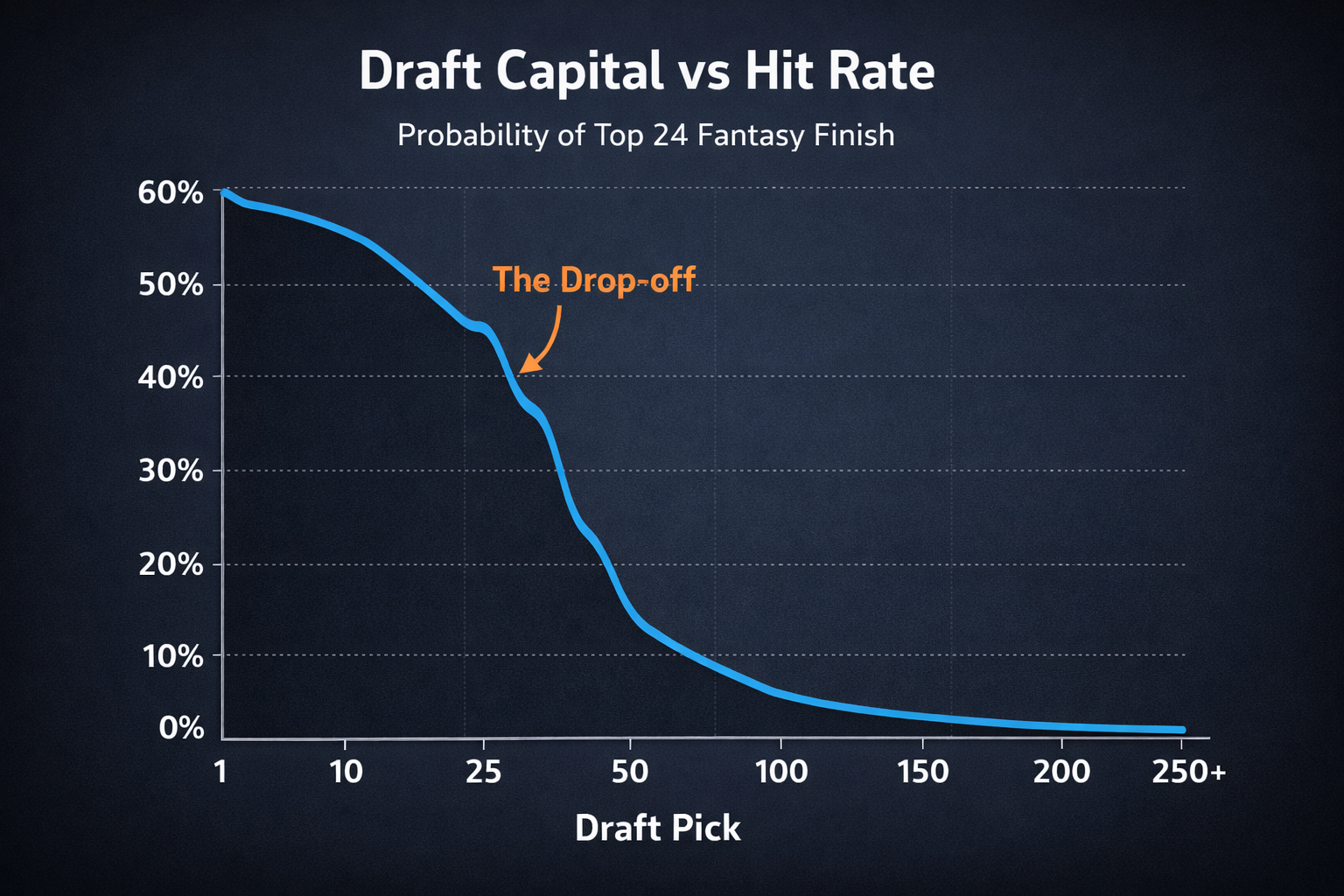
The first episode examines how draft position relates to fantasy outcomes. At a high level, the relationship is straightforward: earlier picks tend to succeed at higher rates. What is less obvious is how quickly that relationship weakens.
What We Found
(While obvious, perhaps,) there is a noticeable decline in hit rates after the early rounds, and beyond a certain point, the probability of producing a fantasy-relevant player becomes very low. That does not mean later picks cannot succeed, but it does mean those outcomes are rare.
At the same time, early selections are not guarantees. A meaningful percentage of highly drafted players fail to produce at a usable level.
Two points follow from this:
- Draft capital is a strong indicator of probability, not certainty
- Late-round success stories are exceptions, not reliable outcomes
Understanding both sides is important. Overconfidence in early picks and overinvestment in late-round upside lead to similar mistakes.
The meat of the episode- how much does draft position actually matter? Episode 1 of the Draft Truth series launches Thursday, April 9th, both here on this blog and on our podcast which you can visit on Apple Podcasts, Spotify, or Acast.
Episode 2: Which College Stats Actually Matter?
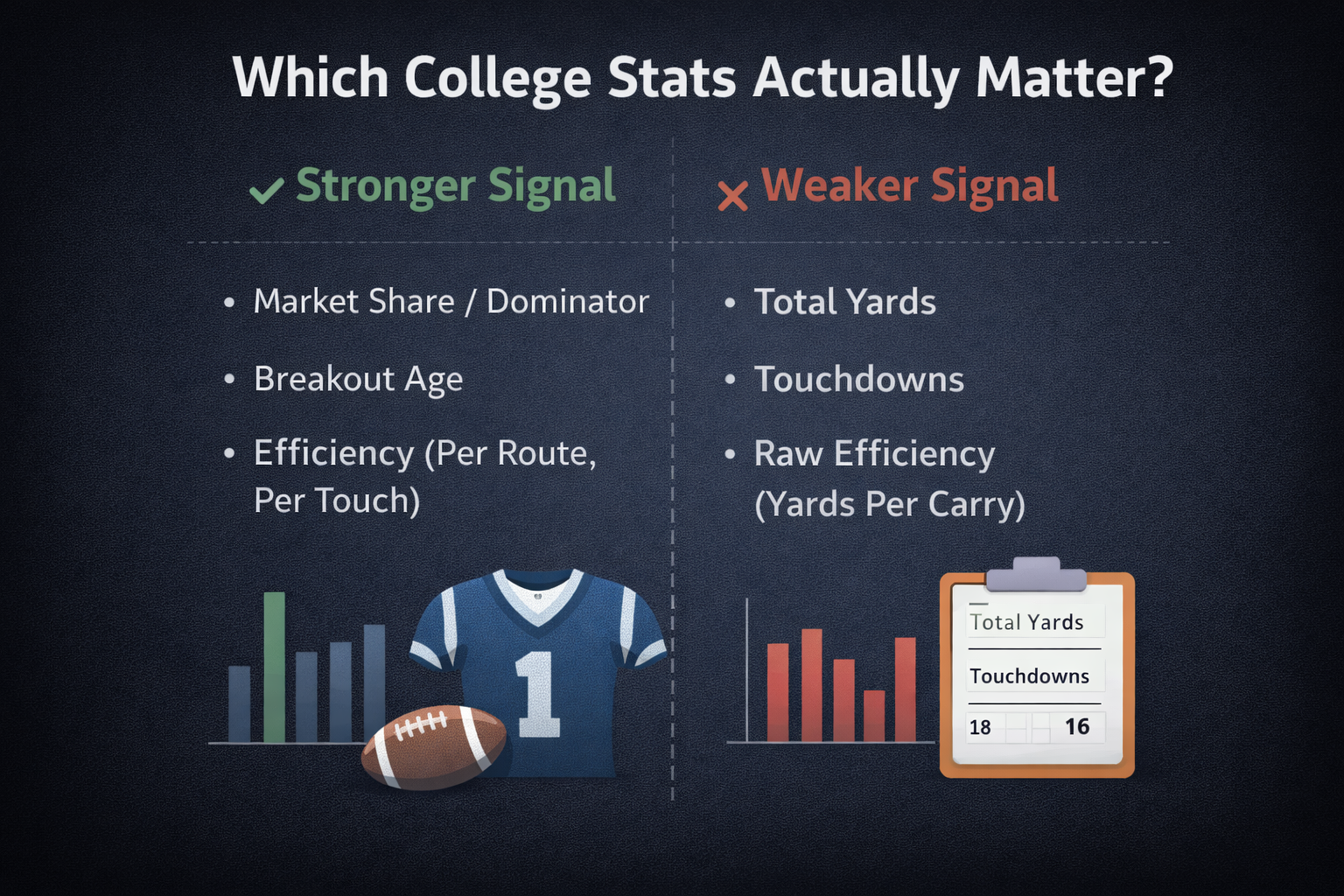
College production is one of the easiest things to point to during draft season, which is part of why it gets used so loosely. Big yardage totals, touchdown counts, market share numbers, efficiency metrics, and highlight plays all get folded together under the same label: production. But those are not the same thing, and they do not tell us the same story.
That is the focus of Episode 2.
Instead of treating college production as one broad bucket, this episode will look at which types of production actually carry predictive value for fantasy football, and which ones are easier to overrate. The goal is not to dismiss college resumes. It is to separate volume from signal.
Some prospects dominate the box score because they are genuinely special. Others benefit from scheme, tempo, surrounding talent, or weak competition. At the same time, some efficient players get overlooked because their counting stats do not look as impressive on the surface. The harder question is not whether production matters. It is what kind of production matters most.
Episode 2 looks at that question directly by comparing the profiles people cite every spring against the outcomes that actually follow. Which numbers hold up? Which ones are mostly noise? And when should fantasy managers trust production over the rest of the draft conversation?
If Episode 1 is about how much draft capital shapes the odds, Episode 2 is about what college performance adds to the picture, and where people tend to misread it. We expect Episode 2 of the Draft Truth series to launch Thursday, April 16th, both here on this blog and on our podcast, which you can visit on Apple Podcasts, Spotify, or Acast.
Episode 3: Athleticism vs Production: What Wins?
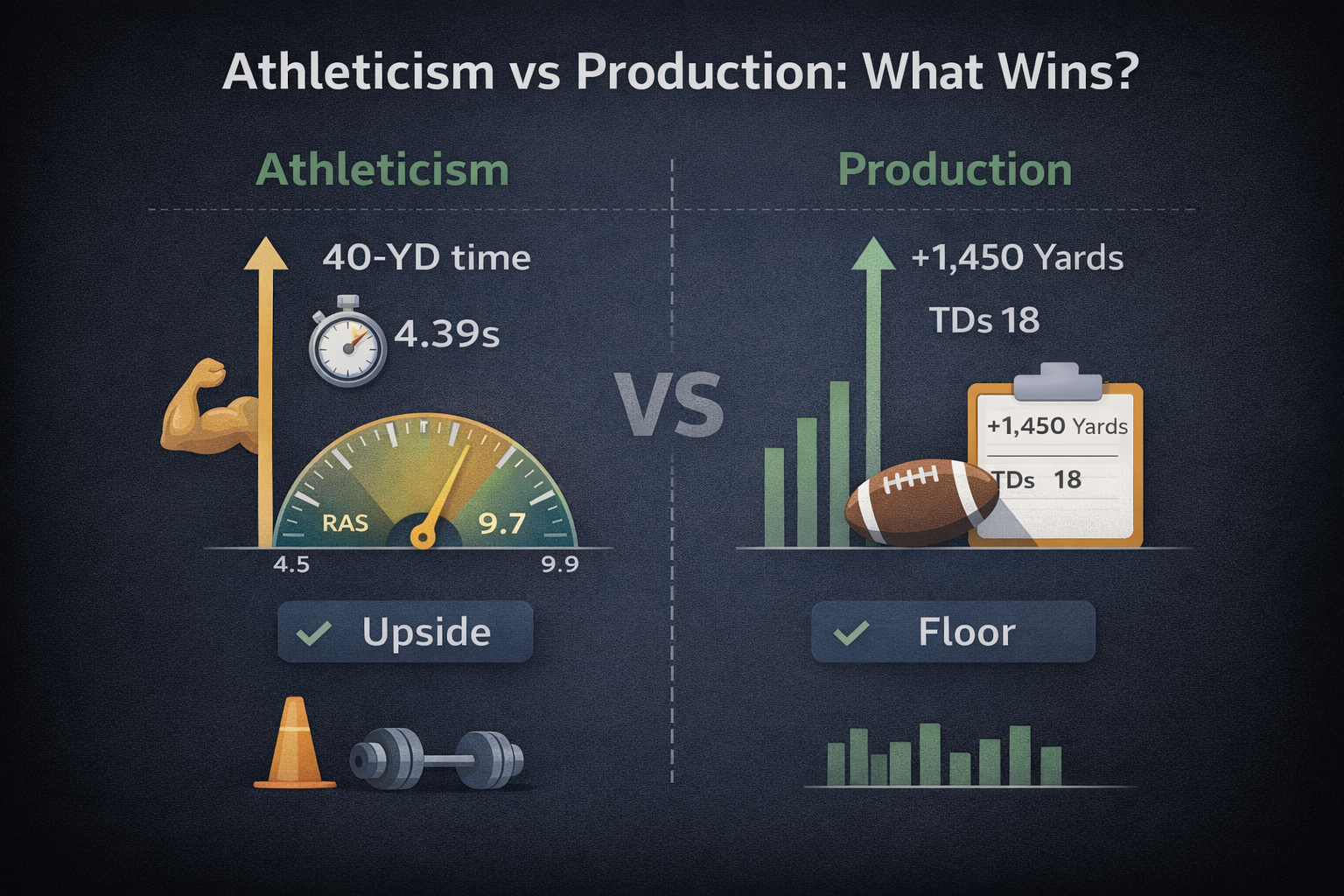
The combine creates some of the loudest moments of the draft cycle. A fast forty can change the way a player is discussed overnight. A strong Relative Athletic Score can become part of a prospect’s identity before he ever takes an NFL snap. Every year, the same question follows: How much should athletic testing actually move the needle?
That is where Episode 3 will go.
Athleticism clearly matters. Explosiveness, speed, size, and movement ability all shape a player’s ceiling. But athletic testing also creates some of the easiest overreactions in the draft process. Great testing can inflate players whose on-field production never matched the hype, while strong producers with ordinary testing numbers can get pushed down more than they should.
This episode examines that tension directly. When production and athleticism point in the same direction, the evaluation is easy. The harder cases, and the more interesting ones, come when they disagree. What should we make of the elite athlete who never truly dominated in college? What about the productive player who checks fewer boxes in Indianapolis? Which profile has historically been safer, and which one tends to get overdrafted by the fantasy community?
The point is not to argue that testing does not matter. It is to understand when athleticism is a real signal, when it is just a tiebreaker, and when it becomes a distraction from more important evidence.
If Episode 1 establishes the power of draft capital, and Episode 2 clarifies which college stats deserve attention, Episode 3 brings the two most common prospect debates together in one place: traits versus production, projection versus proof, upside versus what actually tends to work. We expect Episode 3 of the Draft Truth series to launch Thursday, April 23rd, both here on this blog and on our podcast, which you can visit on Apple Podcasts, Spotify, or Acast.
As the series unfolds, each episode will connect back to the larger Fantasy Football Foundry analytics approach: using research, historical context, and decision-grade fantasy analysis to make rookie evaluation more disciplined and more useful.
Anyway, thanks for reading this far. We're having a fun, football-packed April and we hope you are, too!
-Matt

Comments ()