The NFL Draft Came to Pittsburgh. The NFL Came for Your Wallet.
We drove to Pittsburgh for the NFL Draft. We stood in the rain. We paid $21 for a beer. What we did not get was a football pick. What we got instead was a lesson in what the NFL thinks fans are for.
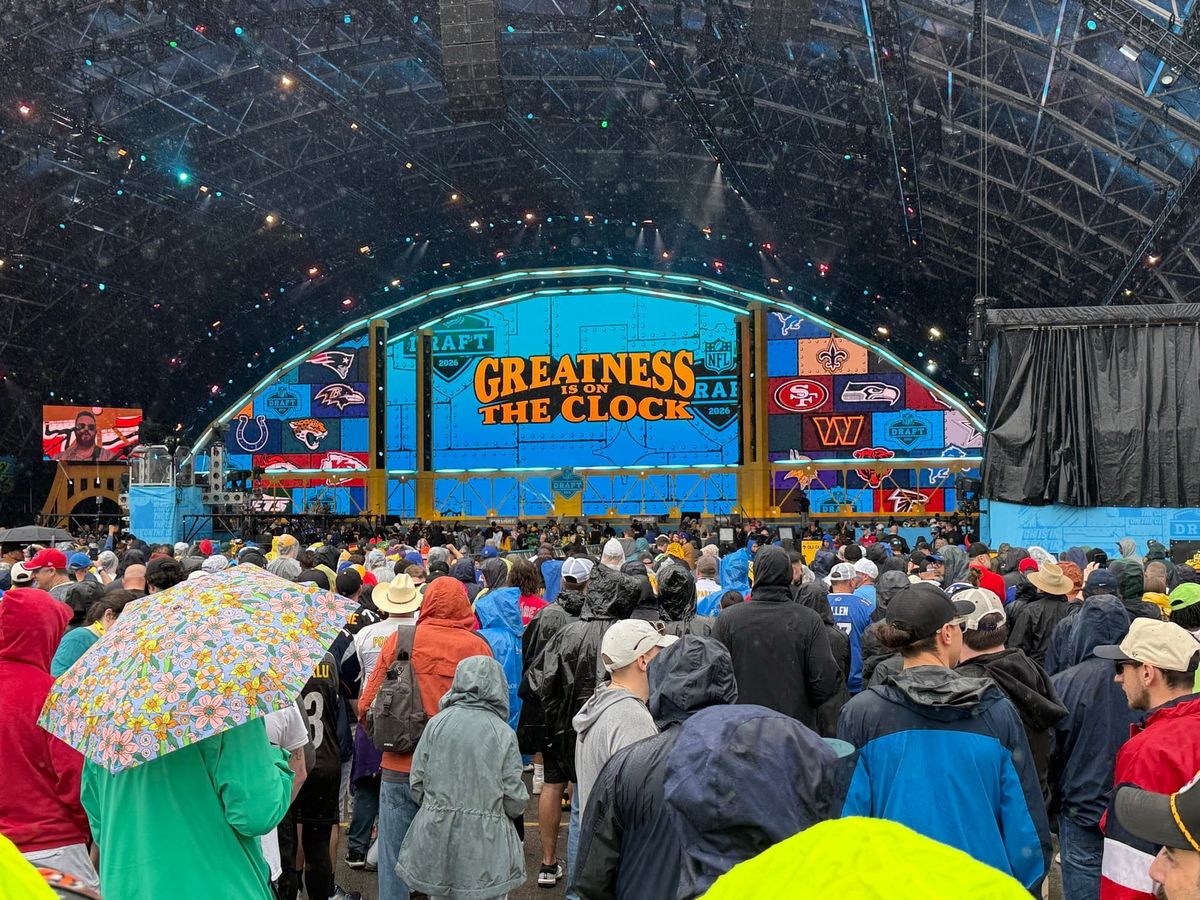
We drove to Pittsburgh for the NFL Draft. We stood in the rain. We paid $21 for a beer.
What we did not get was a football pick.
Day 3 of the 2026 NFL Draft (Rounds 4 through 7, the rounds where rosters are actually built) was supposed to be a reward. Our group of Buffalo Bills fans had made the pilgrimage from across the region, converging on Pittsburgh with the kind of low-key optimism that defines Bills fandom: tempered expectations, genuine excitement, semi-waterproof jackets. The Bills held the first selection of the fourth round. Round 4, Pick 1. The first pick of the day. We had a reason to be there.
We walked up just as festivities were starting. Before the pick was announced, the stage erupted. MCs with microphone volume calibrated somewhere between "tinnitus" and "torture," working the crowd through what can only be described as corporate hype theater: scripted enthusiasm delivered at earsplitting decibels, a kind of performative energy that substitutes noise for substance. Several minutes of this. The crowd, many of whom were already soaked and standing on pavement that had been a parking lot two weeks ago, absorbed it like livestock in a chute.
Brandon Beane caused momentary delay when he swapped neighboring picks with the Las Vegas Raiders. Happy trails, Jermod McCoy! Then we waited some more as a marching band was shuffled on and off the stage and there was more MC screaming.
And then the Bills pick appeared on a video board. Announced from Canadian soil (Niagara Falls, just across the border, by Canadian artist Briony Douglas) billed by the league as the first Buffalo Bills draft pick ever made on Canadian soil. A milestone, apparently. When the dust cleared, the pick had been made not by anyone on stage in Pittsburgh, not in front of the fans who'd traveled for it, but beamed in via screen as a marketing asset.
It didn't stop there. The Bills' next two picks of the round followed the same script. Pick No. 125 (certified Matt Guy, wide receiver Skyler Bell from UConn, who I'd hoped the Bills would snag with their 4.1 pick) came and went. Then pick No. 126, linebacker Kaleb Elarms-Orr from TCU, was handed to Darryl Russell, a Bills superfan from Brantford, Ontario, named the Bills' International Fan of the Year who announced the pick and used the moment to shout out Josh Allen and Hailee Steinfeld. Sweet enough, in isolation. But what are we doing? Zoom out a bit and the pattern becomes impossible to ignore: the NFL had turned the Buffalo Bills' entire fourth round into a Canadian expansion campaign. I know, I know. I get it. The Bills would be nowhere without our neighbors to the north, but is this what anybody wants? Who is Briony Douglas?
We had trekked to Pittsburgh for video board announcements. Three of them.
Let's be clear about one thing: Pittsburgh did not do this to us. The city was a genuinely excellent host. The footprint erected across the riverfront was impressive in scale, thoughtfully laid out, and staffed by locals who seemed actually happy to be there; a rare thing at any large event. Pittsburgh threw itself into this with civic pride, and it showed. Pittsburgh was not the problem. The city deserved a better tenant.
What the NFL erected inside Pittsburgh's hospitality was something else: a commercial campus with a football draft somewhere inside it. Everything had a price. $21.25 for a domestic beer in a 25-ounce can. The league's concession to "value" being that the can is large. $7 for a bottle of water. Pittsburgh-inspired food that ranged from $10 for a Steel City Dog to $15 for a "kielbasa cheesesteak," the city's culinary identity repackaged and sold back to you at event markup. An "Immaculate Refreshment" cocktail for $26.50, a name that manages to simultaneously honor Franco Harris and insult your intelligence.
Here's where I want to be careful, because the easy response is: this is everywhere now, what did you expect? And that's true. Overpriced concessions are a feature of every stadium, every arena, every festival with a captive audience. I know this. You know this. We've all made peace with it to some degree, which is precisely the problem, because normalization is not the same as justification. We're used to being gouged when we have no other options- the airport, the stadium, rest stops. For this predatory business model, we can largely thank companies run by two billionaires- football owner Jerry Jones and his Legends Hospitality and hockey owner Jeremy Jacobs' Delaware North.
The NFL generates $23 billion in revenue annually. Its 32 franchises are collectively valued at $228 billion. Commissioner Goodell has publicly stated his goal of reaching $25 billion in revenue by 2027, a target the league is well on pace to hit, buoyed by an $110 billion media rights package. The Dallas Cowboys alone are worth $13 billion. The Draft is one of the few NFL events with free admission. It's theoretically democratic, a chance for fans of all 32 teams to participate without a ticket price barrier. Honestly, I'm not sure you could charge much more for the event, which boiled down to audio assault in a rainy parking lot.
Someone still decided the math required charging $7 for water. Could the Rooney family (owners of the Steelers) survive without the markup for $7 water? Could the NFL? How much would it have cost to provide free water to attendees? And again, yes, I know there were filling stations for people that happened to bring their own empty plastic water bottle. That is not the point.
The question isn't whether this is normal in 2026. It is. The question is whether normal and acceptable are the same thing, and I'd argue (loudly) that they are not. Why did we let all of this happen? $250 tickets, $180 jerseys, $25 beer and $30 (terrible) food at sporting events. Why are we paying $15 for hot dogs? What is going on?
Nor is the international pick-announcement strategy new or unique to us. In 2026 alone, 29 clubs participated in the NFL's Global Markets Program across 21 international markets, up from 25 clubs just two years prior. The Bills were not special. They were three line items in a spreadsheet. The Green Bay Packers announced a Day 3 pick live from Dublin, Ireland, where an Irish singer-songwriter performed a harp rendition of "Go Pack Go" before reading the card. Truly powerful. The Indianapolis Colts had their pick announced from Berlin by their official German ambassador. The league has franchised the draft announcement itself, turning each team's moment into a billboard for a market the NFL wants to crack.
The players have noticed. Despite record attendance, (805,000 fans over three days in Pittsburgh) only 16 draft prospects showed up in person in 2026. Sixteen. The young men who are ostensibly the reason any of us are standing in the rain have largely concluded that the experience isn't worth it. If that doesn't indict the event, I'm not sure what would.
Critics have been making this case for years. OutKick called the draft "some of the most boring television of the year," a "three day-long press conference, stretched out beyond any and all possible justification in order to get television ratings." ESPN was pilloried for airing 14 commercials between three picks. The draft has become a television program that occasionally interrupts itself with football content.
Which brings you back to the parking lot.
There's a specific feeling that hits when the gap between anticipation and reality collapses all at once. We had arrived with the energy of people who understood they were somewhere that mattered — we are actually here — and then spent the next several hours watching that feeling get methodically disassembled. The MCs. The video board. The pick announced from across an international border. The $21 beer sweating in your hand in the rain. The booths. The activations. The sponsors. By the time the fourth round was over, the question was no longer how do we make the most of this — it was why the hell are we here at all?
Not as a complaint. As a genuine question. Because the NFL has an answer, and it isn't flattering: you are here because your presence validates the spectacle. The crowd shots, the cheering fans, the sea of team colors- that footage exists to sell the draft to markets that are watching from London, Mexico City, São Paulo, Dublin.
You are the atmosphere. You are not the audience.
And yet, we paid it. All of it- the beers, the water. We stood in the rain on a repurposed parking lot and watched a video board and went home and will, in all likelihood, do it again. That's the uncomfortable question underneath all of this: at what point did fans become complicit in their own fleecing?
It happened slowly enough that we never noticed the door closing behind us. The NFL holds something close to a monopoly on a specific kind of American identity. You cannot simply defect to a competing product. There is no competing product. The Bills are The Bills. That is not a preference; it is a fact of who you are, inherited or adopted, worn like a scar. The league understands this with predatory precision. When your product is not a product but a belonging, you can charge whatever you want for the privilege of being near it. Shoutout to all the ratty blue and red zebra patterned knockoff tees that say "MAFIA MEANS FAMILY."
So the prices crept up. A dollar more here. A surcharge there. Ticketmaster trying to murder each and every one of us however they can. Each increase small enough to absorb, to rationalize, to laugh off with the people standing next to you in line. I'm not naive enough to call for a boycott, and I'm not cynical enough to say nothing matters. But naming it honestly feels like a start: we subsidize this. The $228 billion valuation exists because fans like us keep showing up, keep buying in, keep treating access to our own teams as a privilege worth any price the league sets.
The Bills will be fine. The picks will get evaluated in August when we see the roster. Bills Mafia endures.
But standing in the rain, watching our team's moment get outsourced to a video board across an international border while someone screamed into a microphone about the energy in Pittsburgh, it was hard not to feel that the NFL Draft had ceased to be for us. We were the backdrop. The set dressing.
Wet set dressing who paid $7 for water.
Comments ()